
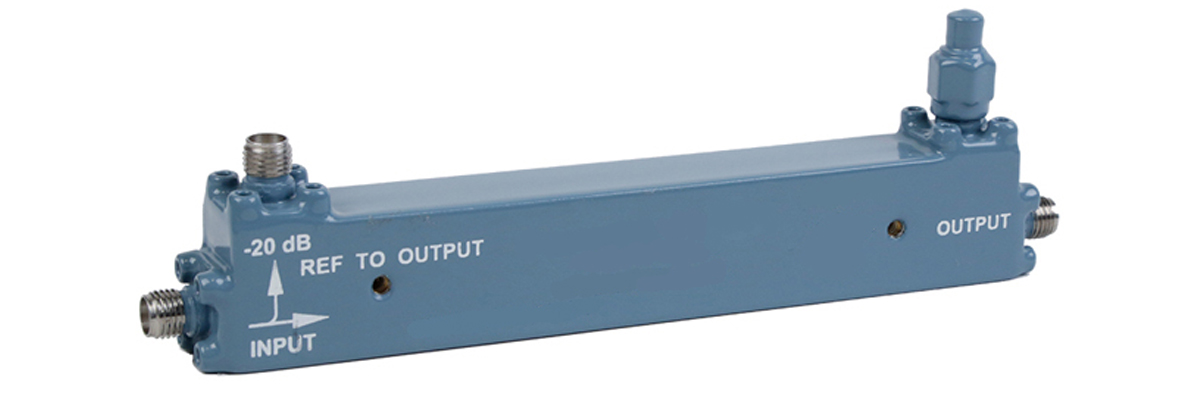
Couplers
The spread of radio frequency technologies used, for example, in automotive radars, 5G cellular communications, the Internet of Things (IoT), leads to an increase in the number of RF signal sources. For their proper operation, it is necessary to monitor the power level, as well as manage it without introducing losses into the transmission lines and load.
In addition, since some applications require a high-power output signal, it is necessary to develop a way to track the output signals without directly connecting sensitive measuring instruments that can be damaged at high signal levels.
Determining the characteristics of an RF load, for example, an antenna in a wide frequency range, as well as tracking changes in the load and the standing wave coefficient during transmission, which is necessary to prevent high-power reflections and harm to the amplifier, is a certain difficulty.
These issues are solved by using directional couplers in the transmission line. They allow careful monitoring of the RF energy flow in the line, reducing the power level by a known fixed amount. During the sampling process, directional couplers introduce minimal distortion into the signal of the main line. They make it possible to distinguish between the energy transmitted in the forward and reflected channels, as well as to track the reverse losses and the standing wave coefficient, so that it is possible to judge the load change during transmission.
Directional couplers are used when measuring the S-parameters of microwave devices as part of panoramic devices for measuring VSWR and attenuation (gain).
They provide high measurement accuracy in a wide frequency range due to high directivity. They are characterized by low power losses in the primary channel.
The couplers have small sizes and various variants of coaxial connectors: type III, IX, I.

